





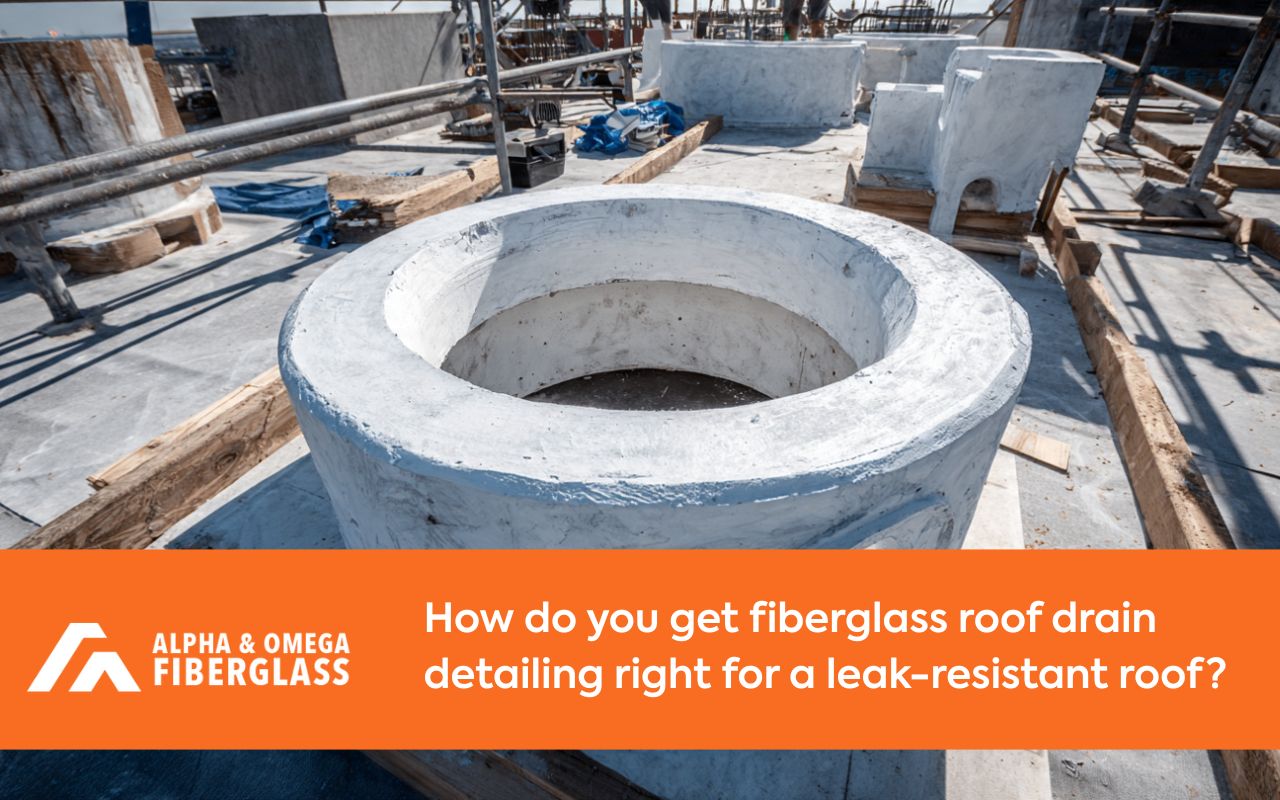
How do you get fiberglass roof drain detailing right for a leak-resistant roof?
Fiberglass roof drain detailing feels complex at first. However, a simple plan keeps water moving. Therefore, you avoid leaks, stains, and costly callbacks. With the right steps, Fiberglass roof drain detailing becomes repeatable. You will focus on drain bowl prep, reinforcement layers, and ponding control. In the end, Fiberglass roof drain detailing protects the roof and extends service life.
How do you get fiberglass roof drain detailing right for a leak-resistant roof?
Fiberglass roof drain detailing works when the drain area is clean, reinforced, and correctly clamped. Moreover, the roof must guide water into the drain without low spots. Therefore, focus on drain bowl prep, reinforcement layers, ponding control, scupper tie-ins, and clamp rings. When these parts align, Fiberglass roof drain detailing stays watertight through storms.
Why fiberglass roof drain detailing matters for long-term performance
First, water always finds the easiest path. So, any weak seam near a drain becomes a future leak. In Fiberglass roof drain detailing, you want fast flow and strong edges. Therefore, you reduce standing water and membrane stress.
Moreover, good drainage lowers the chance of ponding control issues.
Also, clean pathways help strainers and bowls stay clear.
Consequently, you reduce emergency repairs and downtime.
Alpha & Omega Fiberglass designs drain details with durability in mind. As a result, the roof stays stable during heavy rain events.
Drain bowl prep that prevents early failures
Before anything else, drain bowl prep sets the foundation. Therefore, treat it like a critical waterproofing step. In addition, match materials so the system bonds properly.
First, remove dust, loose fibers, and old sealant.
Next, dry the area fully before laminating.
Then, confirm the flange sits flat with no rocking.
Finally, apply compatible sealant where the system requires it.
If you need guidance fast, Alpha & Omega Fiberglass can help you plan the safest approach. For urgent conditions, review Emergency Fiberglass Roof Repair Philadelphia Services.
Reinforcement layers that support the drain zone
Next, reinforcement layers protect the high-stress area around the bowl. Therefore, you reduce tearing and wrinkling during runoff. Also, reinforcement layers spread loads where the membrane transitions.
First, cut reinforcement fabric so it extends beyond the flange.
Next, place it smoothly, and avoid trapped air.
Then, saturate and bond per the system requirements.
Finally, let it cure before installing hardware.
In Fiberglass roof drain detailing, reinforcement layers are the insurance policy. Consequently, the drain detail resists movement and thermal cycling.
Ponding control through pitch and alignment
Even strong laminates fail when water stands too long. Therefore, ponding control must start with slope and layout. Moreover, the drain bowl must sit at the low point.
First, verify the roof plane directs water toward the drain.
Next, correct low spots with tapered solutions when needed.
Also, check transitions near curbs and parapets.
Alpha & Omega Fiberglass often sees leaks that start with small low areas. Therefore, consistent ponding control protects the whole system.
Clamp rings that lock the membrane in place
Clamp rings create the mechanical seal at the flange. Therefore, they must compress evenly. Also, clamp rings should be tightened in a balanced pattern.
Use this simple approach for clamp rings:
First, seat the membrane evenly around the opening.
Next, start bolts by hand to avoid cross-threading.
Then, tighten in a cross pattern for uniform pressure.
Finally, stop before you deform the flange or damage the membrane.
When clamp rings are uneven, Fiberglass roof drain detailing can leak under driving rain. Consequently, take your time on this step.
Scupper tie-ins that add overflow protection
Sometimes, one drain cannot handle peak flow. Therefore, scupper tie-ins provide an extra exit path. Moreover, scupper tie-ins help when debris blocks the primary drain.
For clean scupper tie-ins:
First, seal the scupper box perimeter properly.
Next, add reinforcement layers over stress points.
Then, flash the membrane continuously to the outlet.
If your site needs added drainage routes, Alpha & Omega Fiberglass can recommend safe layouts. You can also explore local service support at Fiberglass Roofing in Norristown, PA | Durable Roof Solutions and Fiberglass Roofing in Phoenixville, PA | Durable & Affordable Solutions.
How to do fiberglass roof drain detailing step by step
This workflow keeps Fiberglass roof drain detailing consistent. Therefore, it reduces guesswork and rework.
First, map drainage paths and confirm low points.
Next, complete drain bowl prep with a clean, dry surface.
Then, install reinforcement layers beyond the flange edge.
After that, set the membrane and verify smooth contact.
Next, install clamp rings and tighten in a cross pattern.
Finally, test flow and confirm ponding control after rinsing.
Alpha & Omega Fiberglass uses repeatable checks at each stage. Consequently, Fiberglass roof drain detailing holds up during real weather.
FAQs
What causes leaks near drains on fiberglass roofs?
Often, leaks come from poor drain bowl prep, weak reinforcement layers, or uneven clamp rings. Moreover, debris can force water to back up. For common drain-area risk points, see Fiberglass Roof Leak Causes Around Curbs and Drains.
How do I confirm ponding control after installation?
First, flood-test lightly and watch where water settles. Next, mark low areas and correct slope if needed. Because cold seasons add risk, also review How Do You Winterize a Fiberglass Roof Before Freeze-Thaw Cycles?.
When should I use scupper tie-ins instead of adding more drains?
Scupper tie-ins help when parapet walls allow a safe overflow path. Moreover, they add redundancy when primary drains clog. If you suspect capacity issues, act early and review Emergency Fiberglass Roof Repair Philadelphia Services.
How can I find a hidden leak near a drain quickly?
Start inside, then trace wet areas to the roof. Next, inspect seams and the drain perimeter closely. For a fast process, use How to Find a Hidden Leak in a Fiberglass Roof in Under 30 Minutes.
How often should a facility inspect drains and clamp rings?
At minimum, inspect seasonally and after major storms. Moreover, clean strainers to prevent backups. For an easy schedule, follow Facility Manager FAQ: 10 Quick Answers for Fiberglass Roof Care.
Next steps for a dependable drain detail
Fiberglass roof drain detailing stays reliable when details are consistent. Therefore, document each step and recheck after storms. If you want expert help, Alpha & Omega Fiberglass can review your drain layout and failure risks. Book a visit through Contact Us | Alpha & Omega Fiberglass Philadelphia, PA.
When you partner with Alpha & Omega Fiberglass, you get practical guidance and durable outcomes. Consequently, Fiberglass roof drain detailing becomes a strength, not a weak point.
